Boon Island Lighthouse
Boon Island probably takes its name from the barrels of food that local mariners would leave tied to the rocks for those lucky enough to make it there after their ship went down. The food was a “boon” to those men.
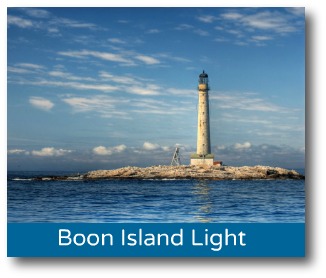 This “island” is a 700' by 300' rock a mere fourteen feet above sea level and about seven miles from shore. It is surrounded by jagged submerged ledges and mercilessly pounded by Atlantic storms.
After numerous shipwrecks, the brand new United States government decided that something had to be done to mark this spot for travelers. So in 1799 a unmanned wooden structure was erected on the rock.
After only five years, in October of 1804, the sea huffed and puffed and blew the whole thing down.
In 1805, a stone tower was put up. Three men drowned during construction. This daytime monument stayed up until the first lighthouse was built in 1811, and the first lighthouse keeper in Boon's history took up residence.
He lasted eight weeks.
The lighthouse, however, lasted until 1831, when a fierce storm came and the ocean took that one, too.
Yet another lighthouse was built from the rubble of the first, until in 1852 money was appropriated for the construction of a permanent lighthouse and keeper's complex.
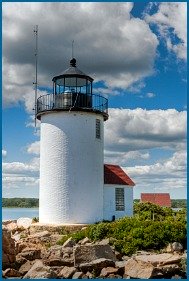
In 1855, the tower that you see in the picture was completed, and there it still stands.
This lighthouse is made of large gray granite blocks hand fitted together and it is lined on the inside with a solid brick wall. If you could get inside, one hundred and sixty-seven steps up a circular iron staircase would take you to the top of the 137 foot structure, the tallest lighthouse in Maine.
Life and Death on The Rock
For such a small, isolated and dangerous spot, a heck of a lot has happened here.
If you sit on Long Sands beach and look at the ledge and its' light out there in the distance, it looks like an exclamation point on the horizon. Lazing in your beach chair with your feet in the water, consider what that craggy spit has witnessed:
In the 1600's and early 1700's, desperate and starving shipwrecked sailors have waited for weeks out there with no shelter, some forced into cannibalizing their dead to stay alive.
Later in its history, lighthouse keepers risked themselves to help men onto the island whose boats had been ripped apart on the submerged ledges that surround it. They gave food and shelter and medicine to sailors waiting out a storm there.
There were usually 3 lighthouse keepers stationed on the island, and each had their own quarters and their own families, complete with children and pets. The keeper's wives became famous for the incredible fish chowder that they made, and boatloads of summer residents could be seen rowing back and forth 14 miles, just for a bowl.
Sometimes the resident families were forced to take shelter in the tower, as wicked storms threatened not only their homes, but their lives. In fact, it was the ferocity of the Great Blizzard of 1978 that put an end forever to lighthouse keepers there.
Today the light is powered by solar panels.
Taking A Closer Look
If you'd like a closer look at Boon Island, it'll be by boat or plane. But if you'd like to also see something
really cool up close, consider going to the
Kittery Naval and Historical Museum
at 200 Rogers Road Extension in Kittery, Maine – just down the road from York.
In the museum you will see a 9 foot tall lighthouse lens valued at over one million dollars. Made in the early 1800's, it is a flawless crystal, French-made, second order Fresnel Lens.
It's the original lens from Boon Island Light.


Return From Boon Island to Southern Maine Lighthouses Page
Return to Inside York Maine Vacations Home Page
Become An Inside York Maine Vacations Fan On Facebook - News, Tips & More!
Enjoy this page? Here's how to add it as a link...
Would you prefer to share this page with others by linking to it?
- Click on the HTML link code below.
- Copy and paste it, adding a note of your own, into your blog, a Web page, forums, a blog comment,
your Facebook account, or anywhere that someone would find this page valuable.